Service
Termite Control
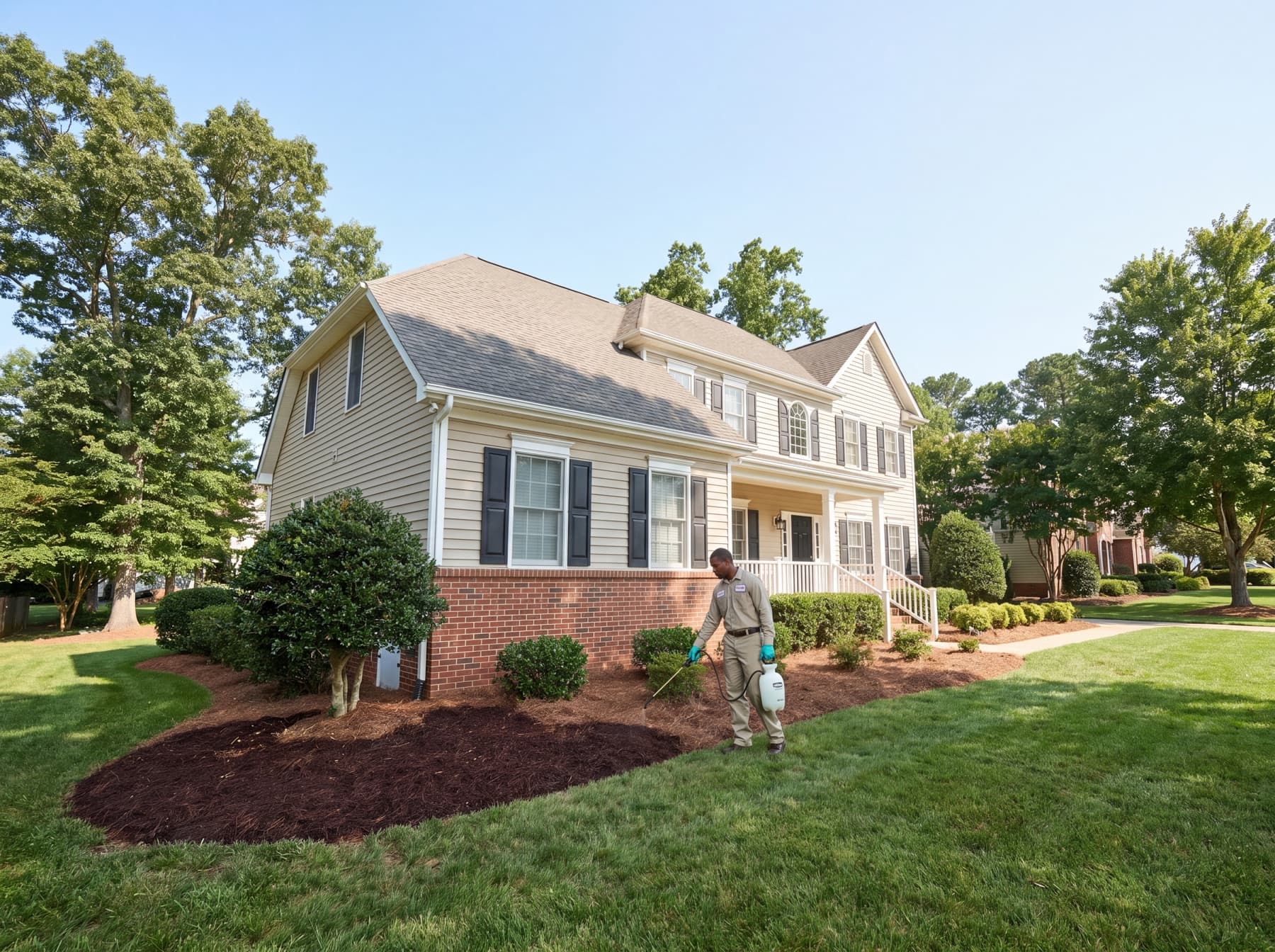
Termite inspection and treatment for the Triad's older neighborhoods and growing subdivisions, including liquid soil treatment, bait station systems, and pre-treatment for additions — every recommendation backed by real evidence like mud tubes, damaged wood, or discarded swarmer wings, not a guess.
More North Carolina homes lose structural wood to termites each year than to fire and severe weather combined, and Greensboro's housing stock makes that statistic feel personal — a century-old crawlspace home in Fisher Park faces the same underlying risk as a slab-built house going up in a newer subdivision near Adams Farm. Termites cause the damage slowly and out of sight, which is exactly why knowing the early warning signs matters as much as knowing who to call once you've spotted one.
What Termite Damage Actually Looks Like
The clearest single sign is a mud tube — a narrow, pencil-width tunnel of packed dirt running up a foundation wall, a crawlspace pier, or an exterior wall. Subterranean termites build these tunnels to shuttle between the soil and the wood they're feeding on while staying shielded from open air and predators, so spotting one is close to a confirmed problem rather than just a maybe.
A few other signs worth checking for around the house:
- Frass that resembles fine sawdust or coffee grounds, often collecting near baseboards or windowsills — this is the calling card of drywood termites, a species that doesn't need direct soil contact to survive.
- Piles of shed wings near entry points after a swarm. Once termite swarmers land somewhere they intend to colonize, they twist off their wings, so a small drift of matching wings on a windowsill is often the very first thing a homeowner notices.
- Wood that sounds hollow or papery when tapped — check exposed trim, deck boards, or structural framing. Solid wood gives a dense knock; wood that's been eaten from the inside sounds noticeably different.
- Doors that suddenly start sticking or floors with a slight new warp to them, which can be an early symptom of structural wood shifting before any damage is visible to the eye.
Brick construction isn't a shield here, and there's a lot of it across older Greensboro neighborhoods — brick veneer is really just a facade over a wood-framed structure, and termites can travel up through weep holes or hairline foundation cracks completely hidden from view until a proper inspection catches it.
DIY Products vs. Professional Treatment
A tiny, isolated drywood infestation — one piece of furniture, say — is about the only scenario where an over-the-counter spray or termite stake has a real shot at working. Beyond that narrow case, DIY products run into the same wall every time: they only treat the surface you can see and reach. A colony living in soil beneath a slab or tucked deep inside a wall cavity is completely untouched by anything sprayed on the outside, so a treated spot can look clean for weeks while the colony keeps eating somewhere else in the structure.
Professional treatment breaks down by termite type and how far the problem has spread:
- Liquid soil treatment builds a continuous chemical barrier around the full foundation footprint, typically applying 100 to 300 gallons of termiticide with licensed equipment homeowners can't buy or use themselves. It's the go-to method for subterranean termites, the species behind most of the termite damage seen in this part of North Carolina.
- Bait station systems, such as Sentricon or Trelona, place monitored stations around the property that worker termites feed on and carry back to the colony, working the problem out at the source rather than just repelling activity away from the house.
- Fumigation, or tenting, gets reserved for severe drywood infestations that have spread widely through a structure — the whole home gets sealed and treated at once instead of chasing one accessible spot at a time.
Key takeaway
A DIY treatment that doesn't work costs more than the price of the product — it gives an active colony extra weeks or months to keep eating, and that gap can turn into tens of thousands of dollars in repair costs. A $500 to $2,500 professional treatment looks expensive next to a $30 spray until you compare it against what it's actually protecting for the next 5 to 10 years.
Termite Treatment Cost Breakdown
| Treatment method | Typical cost |
|---|---|
| Liquid soil treatment | $500 – $1,500 ($3–$16 per linear foot) |
| Bait station system | $800 – $1,500 to install, plus $200–$400/yr monitoring |
| Whole-home fumigation | $2,000 – $8,000 |
Across a full property, overall termite treatment in the Greensboro area typically lands between $225 and $2,500 depending on method and severity. Looked at over a longer horizon, liquid treatment tends to come out cheaper — roughly $1,200 to $1,500 total over five years — compared to a bait system with ongoing monitoring, which runs closer to $2,500 to $4,000 over the same stretch. The tradeoff is that bait systems skip the trenching and drilling a liquid barrier requires, which matters more on some properties than others depending on landscaping right up against the foundation.
How Long Treatment Actually Takes
The service visit itself — inspection included — usually wraps up in under a day for a typical single-family home. Actual elimination speed depends on the method chosen. Liquid barriers start killing on contact within days and reach full effectiveness across the colony within a few weeks. Bait stations move slower by design, since the whole approach depends on termites carrying bait back to the nest themselves — expect 15 to 90 days typically, and up to six months in some cases before the colony is fully gone. Fumigation eliminates active drywood activity the fastest but requires vacating the home for 24 to 72 hours while it's underway.
Pre-Treating New Additions and Construction
Treating open soil before a foundation gets poured is already standard on new home construction, and the same logic carries over to additions on existing Greensboro homes — a new sunroom, garage conversion, or slab extension opens a fresh path for subterranean termites if the soil underneath doesn't get treated first. It's far simpler and cheaper to apply a liquid barrier to bare soil before framing starts than to go back later and treat around cured concrete, which usually means drilling through the slab to reach the soil below.
Anyone planning an addition should ask the contractor directly whether pre-treatment is already part of the scope or needs to be scheduled separately with a licensed pest company. It's an easy step to lose track of during a renovation, and missing the window before the pour locks in the more expensive, more invasive fix later.
Frequently Asked Questions
What does it mean if I see flying, swarming termites? A swarm means there's an active, established colony nearby — swarmers are the reproductive termites a mature colony sends out to start new ones. Cleaning up a pile of dead swarmers doesn't address anything; the colony that produced them still needs a full treatment plan.
How do I check a brick home for termites specifically? Pay close attention to weep holes — the small gaps along the bottom row of brick veneer meant to let moisture escape. Termites use these same openings to travel from the soil up into the wall cavity, often completely out of sight from a casual walk around the house.
Does homeowners insurance cover termite damage? Almost never. Insurers generally classify termite damage as a preventable maintenance issue rather than a covered peril, similar to how they treat gradual water damage from a leak nobody fixed. Routine termite protection is the actual substitute for coverage that doesn't exist.
Is pre-treatment worth it for a small addition? Yes — the cost of treating exposed soil before a small addition's slab is poured is minor compared to what it costs to treat around finished concrete afterward, and it removes one more path for termites to reach the new structure from day one.
Where We Offer Termite Control
What Homeowners Look For
A few things customers consistently tell us matter most.
Frequently Asked Questions
Ready to get this fixed?
Call now or request a free estimate — we'll get back to you fast.