Service
Rodent Control
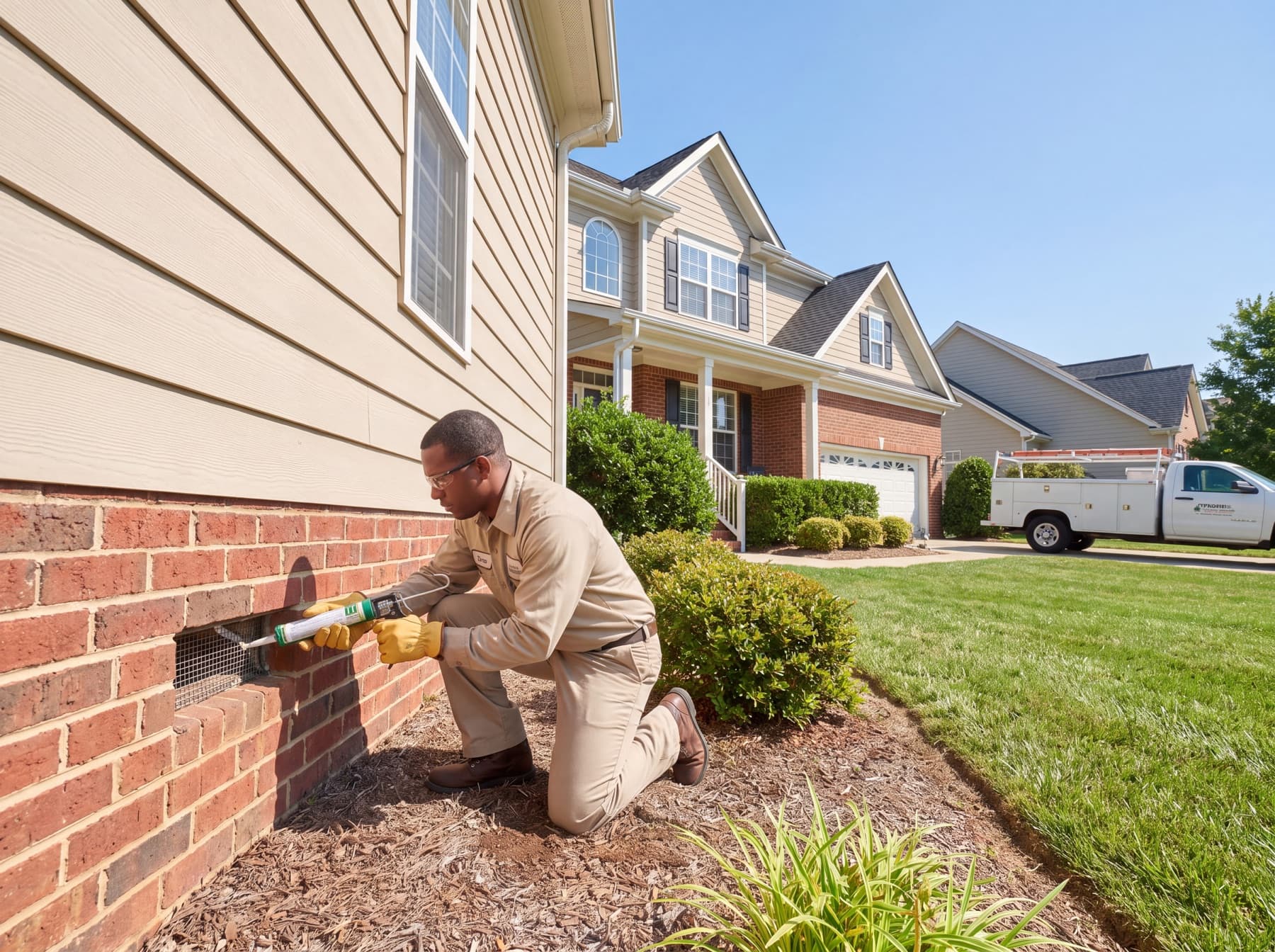
Rodent exclusion and removal for mice and rats in attics, crawlspaces, and wall voids across the Triad. We locate and seal the entry points first, then handle trapping and cleanup — sealing the gaps is what actually keeps them from coming back.
A mouse or rat looking for a way indoors doesn't care whether it's eyeing a pier-and-beam home near Lindley Park with decades-old crawlspace vents or a newer slab house out toward Kernersville — both offer the same three things: shelter, food, and a gap big enough to squeeze through. Rodents move mostly at night and stay hidden in walls, attics, and crawlspaces during the day, so by the time most homeowners notice something's wrong, the activity has usually been going on for a while already.
Spotting a Rodent Problem Early
Droppings are typically the first clue people catch. Mouse droppings run small and smooth with pointed ends — roughly 1/8 to 1/4 inch — and turn up in pantries, under the kitchen sink, along baseboards, or inside a chewed-open cardboard box. Rat droppings are noticeably bigger, shiny and black, around 1/2 to 3/4 inch long. Freshness is a useful clue too: recent droppings look dark and slightly moist, while older ones dry out, lighten to gray, and crumble at a touch.
Beyond droppings, watch for:
- Chew marks — rats leave gouges around 1/8 inch, mice leave smaller and scratchier marks. Both will gnaw through cardboard and plastic without hesitation, and chewed wiring behind a wall isn't just a nuisance, it's a genuine fire risk.
- Noises after dark — rats tend to be heard higher up, in attic spaces or along the roofline, with a heavier scratching or gnawing sound; mice show up more in wall cavities with a lighter, higher-pitched squeak.
- Grease-dark smudges tracing along a wall or baseboard where the same rodent has repeatedly brushed past on its route.
- Nesting material — shredded paper, torn insulation, fabric scraps, bundled into a quiet, undisturbed corner of an attic or behind stored boxes nobody's moved in months.
Traps and Bait vs. a Professional Approach
A single mouse that wanders into a garage is often manageable with a snap trap or an off-the-shelf bait station. Beyond that isolated case, the same limitation shows up every time: store-bought options don't reach rodents already established inside wall voids or attic insulation, and rats are sharp enough to start avoiding a trap once they've watched — or smelled — another rat get caught in it. Setting a few traps in the kitchen might thin out what you're seeing on the surface without ever touching the nest that keeps producing more.
A professional approach tackles the problem from two angles at once:
- Exclusion work — locating and permanently closing off every gap a rodent could use to get in. This is the part that actually stops the cycle, since mice can squeeze through an opening about the size of a dime (roughly 1/4 inch) and rats need only a quarter-sized gap (about 1/2 inch). On Triad homes, the usual suspects are vents, utility line penetrations, foundation gaps, and soffits that have warped or pulled loose over time.
- Trapping placed with actual evidence — droppings, chew marks, grease trails from a real inspection, not a guess — followed by a return visit to confirm the activity has actually stopped rather than just gone quiet for a few days.
Key takeaway
Trapping without sealing the entry point only manages symptoms — another rodent will eventually find and use the same opening. A rodent job worth paying for includes exclusion, not trapping alone.
Rodent Control Cost in the Greensboro Area
Basic trap-and-bait extermination, for mice or rats, generally runs $150 to $550. Exclusion — the work that actually keeps them from returning — scales with the scope of the job:
- $25 to $75 per entry point when it's priced individually for a small, isolated issue.
- $250 to $1,000 flat for sealing a smaller home with a limited number of access points.
- $600 to $1,500 or more for a larger house or one with multiple entry points and attic activity.
- $500 to $3,000+ for a full-property seal on an older or larger home, where crawlspace foundations push the price higher than a comparable slab-built house because of the extra labor involved.
A complete plan — exclusion plus one or two follow-up visits to make sure the seal is holding — typically runs $600 to $1,400 for a standard single-family home, and it tends to be a better long-term value than paying for repeated trap-only visits that never touch the actual entry point.
How Often Rodent Service Is Actually Needed
Most Triad homes don't need rodent control on the same recurring schedule as general pest service. It's usually project-based — an inspection, exclusion work, and trapping to clear whatever's active, followed by a warranty period rather than a standing visit calendar. That said, homes with known risk factors — an aging crawlspace foundation, mature trees overhanging the roofline, or a history of past activity — sometimes fold a rodent check into their regular quarterly pest visit as a low-cost way to catch a repeat problem early.
Attic Entry Points Aren't the Same as Crawlspace Entry Points
Where the activity is happening usually points straight to the fix. Attic problems in this area most often trace back to roofline issues — a warped fascia board, a spot where a tree limb overhangs and gives easy access to the roof, or torn screening on a soffit vent. Tree-heavy streets around Sunset Hills and Latham Park make that last path especially common, since mature canopy puts a branch-to-roofline route within easy reach. Crawlspace activity, more typical of the Triad's older pier-and-beam housing, usually comes down to a foundation vent with damaged or missing screening, a loose seal around a plumbing penetration, or a crawlspace access door that doesn't close tightly.
Because those causes are so different, a proper inspection checks both areas on their own terms rather than assuming a fix in one location covers the whole house — it's entirely possible for a home to have separate, unrelated rodent activity going on in the attic and the crawlspace at the same time.
Frequently Asked Questions
How quickly can rodents actually be gotten rid of? Visible activity usually drops within days of trapping and exclusion starting, with most homes fully resolved within one to two weeks once every entry point identified during the inspection has been sealed.
Can rodents get back in after exclusion work is done? Only if a new gap opens up somewhere — settling, storm damage, or a repair that wasn't sealed back properly — or if an existing seal fails. Done correctly, exclusion is meant to be permanent, which is exactly why a follow-up visit to verify the seal is holding matters.
How do you get rid of the smell after mice are gone? Removing droppings, nesting material, and any deceased rodents, then treating the area with an enzyme-based cleaner, usually clears the smell within a few days. If odor lingers well past that, it often points to a dead rodent in a spot that's hard to reach, like inside a wall cavity or deep in attic insulation.
Do ultrasonic pest repellers actually work? There's no consistent evidence that they do — rodents tend to get used to the sound fairly quickly and go right back to normal activity. They're not a real substitute for exclusion and targeted trapping, whatever the packaging claims.
Where We Offer Rodent Control
What Homeowners Look For
A few things customers consistently tell us matter most.
Frequently Asked Questions
Ready to get this fixed?
Call now or request a free estimate — we'll get back to you fast.